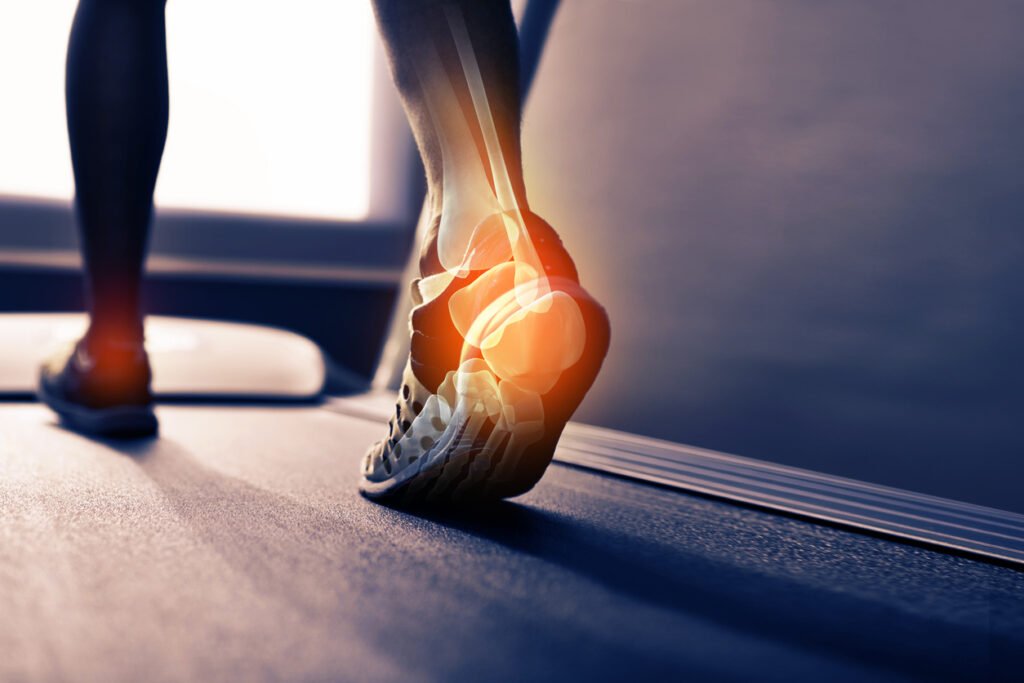
Achilles tendinopathy is a common cause of heel/ankle pain. It can affect runners and athletes, but also occurs in people whose daily activities place repeated stress on the tendon. Symptoms often include morning stiffness, tenderness and pain during walking, running, stairs or calf raises.
Although it was traditionally called “Achilles tendonitis”, the problem is not always driven by inflammation alone. “Tendinopathy” is a more accurate term because it describes changes in the tendon’s structure and its ability to tolerate load.
Understanding the Achilles tendon
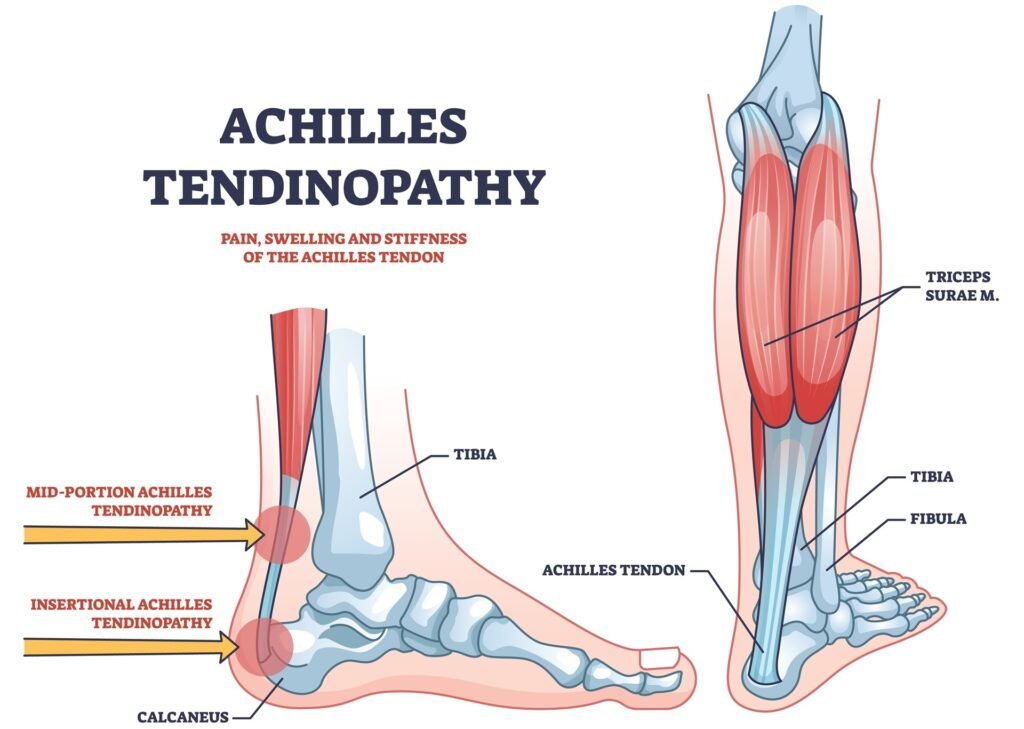
The Achilles tendon is the strong cord-like structure at the back of the ankle. It connects the calf muscles—the gastrocnemius and soleus—to the heel bone, called the calcaneus.
When the calf muscles contract, the Achilles tendon transfers force to the foot. This allows you to lift your heel, push off while walking, run, jump and climb stairs. Because it repeatedly handles forces several times your body weight, the tendon needs adequate strength and recovery time.
What happens in Achilles tendinopathy?
Tendinopathy commonly develops when the load placed on the tendon increases more quickly than the tendon can adapt. This might follow a sudden increase in running distance, hill training, sport or prolonged walking.
The tendon initially attempts to respond and repair itself. If excessive loading continues without enough recovery, its normal collagen fibres can become less organised. The tendon may become thicker, more sensitive and less able to store and release energy efficiently.
Importantly, tendon changes seen on an ultrasound or MRI do not always match a person’s pain. Some people have visible tendon changes without symptoms, while others experience significant pain with relatively minor imaging findings. Diagnosis is therefore based mainly on the person’s symptoms and physical assessment—not imaging alone.
Mid-portion versus insertional Achilles tendinopathy
There are two main types:
Mid-portion Achilles tendinopathy causes pain approximately 2–6 centimetres above the heel bone. The middle section of the tendon may feel thickened or tender. Pain is usually brought on by running, jumping or repeated heel raises.
Insertional Achilles tendinopathy affects the point where the tendon attaches to the heel bone. Pain is felt lower down, directly at the back of the heel. This area can be irritated by pressure from footwear and by compression when the ankle bends upwards—for example, during deep squats, uphill walking or lowering the heel over the edge of a step.
This distinction matters because insertional tendinopathy often requires exercises to be modified initially to reduce compression at the heel.
Common risk factors
Achilles tendinopathy usually results from a combination of factors, including:
- A sudden increase in running, sport, walking or gym training
- Reduced calf strength or endurance
- Limited ankle movement
- Changes in footwear, training surface or running terrain
- Increasing age or a previous tendon injury
- Higher body weight
- Diabetes, high cholesterol or inflammatory conditions
How does a physiotherapist assess it?
Your physiotherapist will ask where the pain is located, when it started and which activities aggravate it. Morning stiffness, pain at the beginning of activity and symptoms after exercise are common features.
The assessment will include checking ankle movement, calf strength, walking or running mechanics, balance and the ability to complete single-leg heel raises, hopping or other task-specific movements. The tendon and surrounding structures will also be examined.
Imaging may be recommended if the diagnosis is unclear, a tear is suspected or symptoms are not improving as expected.
What else could cause pain in this area?
Not every pain behind the heel is Achilles tendinopathy. Possible differential diagnoses include:
- A partial or complete Achilles tendon tear
- Retrocalcaneal bursitis
- Irritation associated with a prominent heel bone or Haglund deformity
- Calf muscle injury
- An ankle joint problem or calcaneal stress fracture
- Sural nerve irritation or referred pain from the lower back
- Less commonly, a blood clot in the calf
A sudden snap, marked bruising, inability to push off the foot, or a hot and significantly swollen calf requires prompt medical assessment.
Physiotherapy treatment
The foundation of treatment is a gradual, individualised tendon-loading program. Complete rest may settle symptoms temporarily, but it does not rebuild the tendon’s capacity.
Treatment may include:
- Temporarily adjusting running, jumping, hills or other aggravating activities
- Progressive calf strengthening
- Gradually introducing heavier, faster and sport-specific exercises
- Addressing ankle mobility, balance and movement patterns
- Footwear advice or a temporary heel lift when appropriate
- A structured return-to-running or return-to-sport plan
For insertional tendinopathy, heel raises may initially be performed from the floor rather than over the edge of a step. This reduces compression where the tendon attaches to the heel.
Can LASER therapy help?
Laser therapy, uses selected wavelengths of light to interact with light-sensitive components within cells. It may assist with short-term pain modulation and support the local healing environment.
Laser therapy can be considered as an adjunct to exercise, particularly when pain is limiting rehabilitation.
Recovery often takes several months rather than several days. At Essential Health Physiotherapy, we assess the type of Achilles problem, identify contributing factors and develop a rehabilitation program matched to your symptoms, activities and goals.
If you’re frustrated by heel pain stopping you running, jumping & walking, book your physiotherapy assessment & treatment now!
If your nagging heel pain is stopping you from walking or running, call us at 07 3132 0898 to get back to moving pain-free.
References
Chimenti, R. L., Neville, C., Houck, J., Cuddeford, T., Carreira, D., & Martin, R. L. (2024). Achilles pain, stiffness, and muscle power deficits: Midportion Achilles tendinopathy revision—2024. Journal of Orthopaedic & Sports Physical Therapy, 54(12), CPG1–CPG32. doi:10.2519/jospt.2024.0302
Martimbianco, A. L. C., Ferreira, R. E. S., Latorraca, C. O. C., Bussadori, S. K., Pacheco, R. L., & Riera, R. (2020). Photobiomodulation with low-level laser therapy for treating Achilles tendinopathy: A systematic review and meta-analysis. Clinical Rehabilitation, 34(6), 713–722. doi:10.1177/0269215520912820
Pringels, L., Capelleman, R., Van den Abeele, A., Burssens, A., Planckaert, G., Wezenbeek, E., & Vanden Bossche, L. (2025). Effectiveness of reducing tendon compression in the rehabilitation of insertional Achilles tendinopathy: A randomised clinical trial. British Journal of Sports Medicine, 59
(9), 640–650. doi:10.1136/bjsports-2024-109138
In-text citations: (Chimenti et al., 2024), (Martimbianco et al., 2020), and (Pringels et al., 2025).
Check our Previous Blogs
- Dizzy When Rolling in Bed? BPPV and Physiotherapy Treatment
- Plantar Fasciitis: The Real Reason That Heel Pain Keeps Coming Back
- 7 Essential Tips to Beat Frozen Shoulder and Get Your Movement Back
- Ehlers Danlos Syndrome (EDS): Exercising Safely With Dysautonomia
- Cervical Radiculopathy: Symptoms, Causes and Physiotherapy Treatment