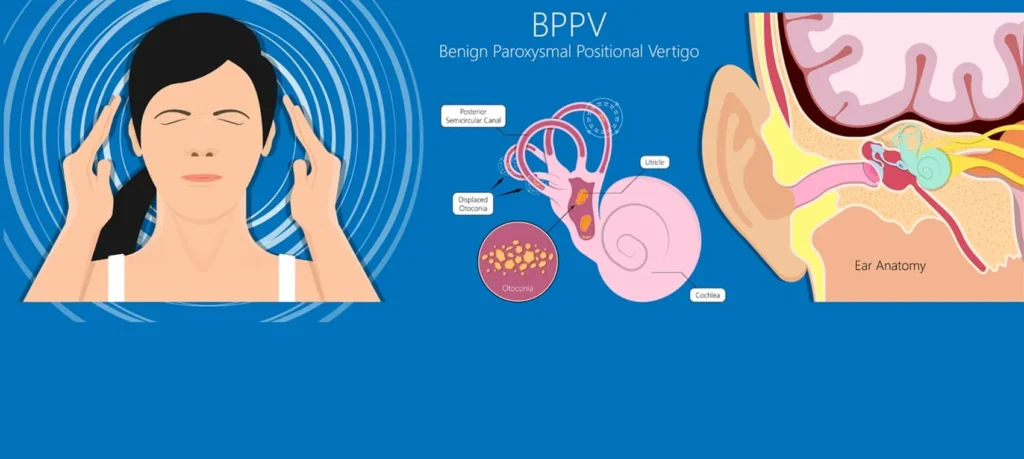
Does the room spin when you roll over in bed, turn your head, look up or bend down? These brief & intense episodes can be caused by Benign Paroxysmal Positional Vertigo (BPPV). Although debilitating, this inner-ear problem does respond well to treatment by our physiotherapists trained in vestibular rehabilitation.
What is BPPV
Benign means it is generally not life-threatening. Paroxysmal means sudden, short episodes. Positional means symptoms are triggered by head position. Vertigo describes the sensation that you or the room is spinning.
What causes BPPV
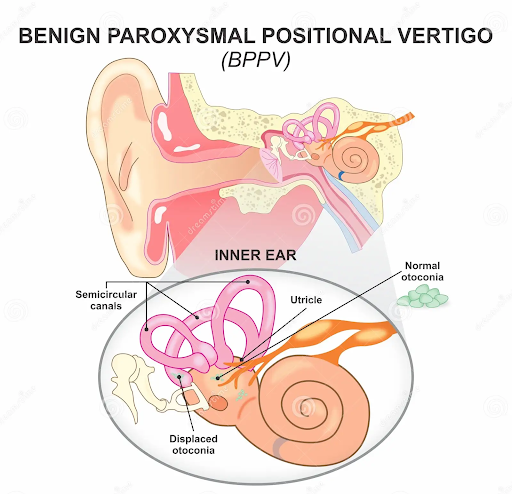
Deep inside each inner ear are tiny calcium carbonate crystals called otoconia. They normally sit in the utricle and help the brain detect gravity and straight-line movement. In BPPV, some crystals become dislodged and move into one of the semicircular canals, which normally detect head rotation.
When you move your head relative to gravity, the particles shift through the canal fluid and bend delicate sensors. The brain receives an inaccurate message that the head is rotating. The mismatch between signals from the inner ears, eyes and body creates vertigo and flickering eye movements called nystagmus. The posterior canal is affected most often, although other canals can be involved.
Who gets BPPV
BPPV can affect adults of any age, but it becomes more common with ageing and occurs more often in women. Many cases have no obvious cause. Risk factors include head injury, osteoporosis or low vitamin D and prolonged bed rest.
Common triggers and aggravating movements
Typical attacks are triggered by rolling in bed, laying back, getting up, turning the head quickly, looking upwards, bending down or tipping the head back at the hairdresser or dentist. Spinning usually starts after a brief delay and settles within one minute, although nausea or unsteadiness may last longer. Avoiding movement because of fear can reduce confidence and increase fall risk.
How a Physiotherapist assesses BPPV
Our physiotherapists will question when the dizziness began, how long it lasts, what triggers it and whether there are hearing changes, headache, fainting or neurological symptoms. We will assess eye movements, balance, walking, coordination and neck movement to check whether the pattern fits BPPV and positional testing is safe.
The Dix-Hallpike test is commonly used for posterior canal BPPV, while a supine roll test assesses the horizontal canals. Your physiotherapist will support your head in specific positions while watching the direction and duration of nystagmus. This identifies the affected ear and canal. Symptoms alone cannot confirm BPPV because migraine, blood-pressure changes and neurological or other inner-ear conditions can feel similar.
How Physiotherapy treats BPPV
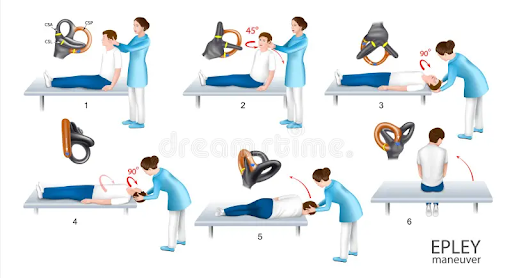
Treatment is selected for the affected canal. Posterior canal BPPV is often treated with the Epley manoeuvre, a sequence of supported positions that uses gravity to guide particles back towards the utricle. Horizontal canal BPPV needs a different technique, such as a barbecue roll or Gufoni manoeuvre. Some people require a repeat treatment.
Testing and treatment can be modified for neck or back limitations, and eye movements are reassessed afterward. If imbalance or motion sensitivity remains, rehabilitation may include balance exercises, gradual movement exposure and gaze-stability work. Education about falls, safe activity and recurrence is also important. Anti-nausea medicines may ease symptoms temporarily, but they do not reposition the crystals.
Possible side effects of BPPV treatment
Repositioning manoeuvres reproduce the problem position, so a short burst of vertigo is expected. Temporary nausea, occasional vomiting, light-headedness or a sense of falling can occur. Some people feel off-balance afterward. Less commonly, particles move into another canal, changing the symptoms and requiring a different manoeuvre. Neck or back discomfort is possible, so discuss relevant conditions before treatment. Avoid repeatedly trying online manoeuvres until a trained clinician identifies the correct side and canal.
Red flags and when to seek urgent medical attention
Not every episode of vertigo is BPPV. Go to the nearest emergency department or call Triple Zero (000) if dizziness or vertigo occurs with difficulty walking or coordinating movement, double vision, weakness or numbness, facial droop, slurred speech, difficulty swallowing, confusion, collapse, chest pain, or a sudden severe headache. Sudden hearing loss also needs urgent medical assessment. Continuous severe vertigo that is not clearly linked to movement, especially with new neurological symptoms, should not be treated as routine BPPV.
When should you book a physiotherapy assessment
If you experience room spinning when rolling in bed, turning your head, looking up or lying down, arrange an assessment rather than avoiding movement. We can determine whether BPPV is likely, identify the affected canal, provide appropriate treatment and refer you for medical review when the pattern is atypical.
Need help with positional dizziness? Call us at 07 3132 0898 to ask about a vestibular physiotherapy assessment and take the first step towards moving with greater confidence.
Clinical sources
• Healthdirect Australia Vertigo
• American Academy of Otolaryngology Head and Neck Surgery Clinical Practice Guideline BPPV Update
• Royal Australian College of General Practitioners The Epley manoeuvre for BPPV
• von Brevern and colleagues Epidemiology of BPPV
• Chen and colleagues Risk factors for BPPV occurrence
Check our Previous Blogs
- Frozen Shoulder: Why It Takes Months to Heal and What Actually Speeds Recovery
- Neck Pain and Headaches: Why the Problem Is Often Higher Up Than You Think
- Bone on Bone? What Your Knee X-ray Isn’t Telling You
- IT Band Syndrome: Why Your Outer Knee Hurts When Spring Running Ramps Up
- Sprained Ankle Playing Sport? Here’s What to Actually Do