
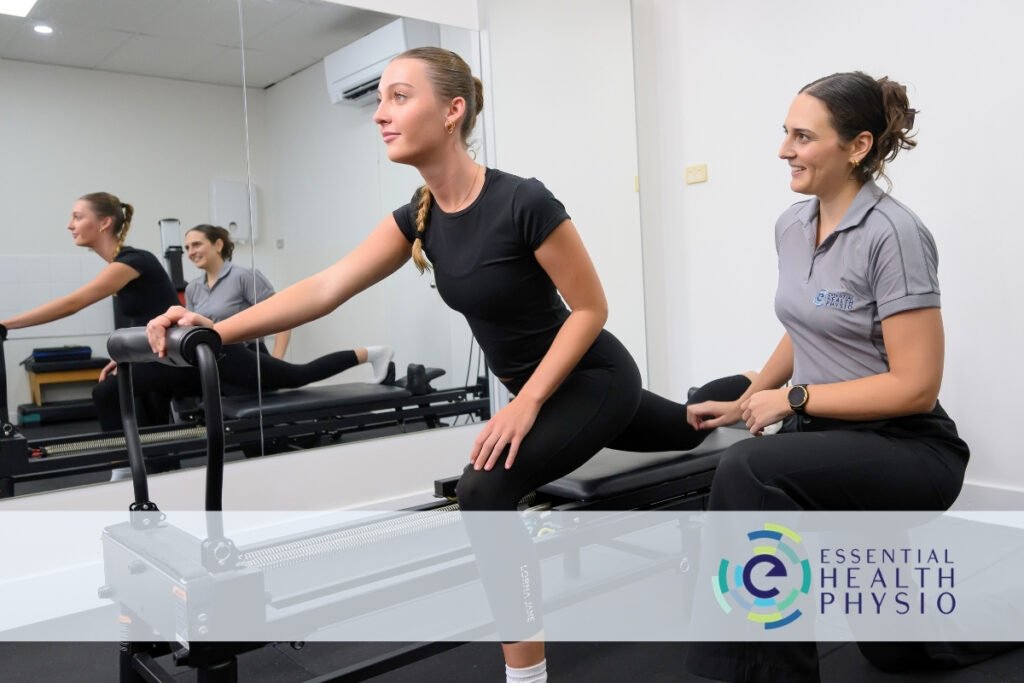
You already exercise. You have probably tried Pilates before, or at least considered it. But then your physio or GP mentions “Clinical Pilates,” and suddenly it is not clear what that actually means, or whether it is meaningfully different from the class at your local gym.
The short answer: it is different, and the differences matter if you are managing chronic pain or coming back from injury. Here is a clear breakdown of clinical pilates vs regular pilates so you can make a genuinely informed decision before committing to a program.
What Regular Pilates Is Designed to Do
Regular Pilates is a movement-based exercise system focused on building strength, flexibility, and body awareness. When delivered well, it is genuinely useful for general fitness. Classes typically run in groups, led by a certified Pilates instructor, and built around standardised exercise sequences.
The limitation is not that regular Pilates is bad. It is designed for generally healthy people. A typical gym-based class runs with eight to fifteen participants. The instructor may cue form corrections, but they do not have the clinical training to identify how a chronic lower back issue changes the way your hip moves, or whether a particular exercise is loading your knee differently than intended.
If you have had a knee reconstruction, a disc bulge, or six months of persistent shoulder pain, a standard group class was not built with you in mind.
What Makes Clinical Pilates Different
Clinical Pilates is delivered by AHPRA-registered practitioners, typically physiotherapists or exercise physiologists with university-level training in anatomy, physiology, and musculoskeletal assessment. That distinction changes what is possible in the room.
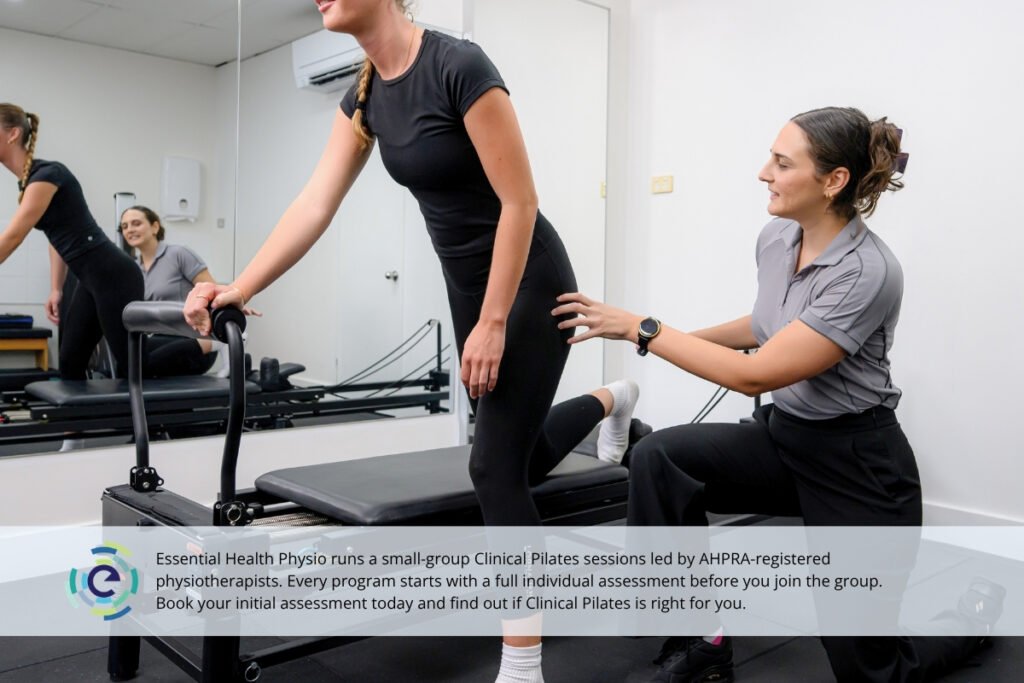
At Essential Health Physio’s Birkdale clinic, classes are kept to fewer than five participants. That is a deliberate choice. It allows the treating physiotherapist to watch your movement closely, adjust exercises in real time, and tailor the program to your specific condition rather than fitting you into a generic sequence.
The exercises themselves also target different things. Regular Pilates tends to work through larger movement patterns. Clinical Pilates focuses on the deeper stabilising muscles, the ones responsible for controlling pelvic position, spinal alignment, and the smaller movements that standard exercise often bypasses. Core activation, pelvic floor engagement for women’s health conditions, breath coordination with movement, and postural awareness are all addressed within a clinical session.
The Assessment Before You Start
One of the most meaningful differences between the two approaches is what happens before you ever attend a class.
At Essential Health Physio, every participant in the Clinical Pilates program completes a one-on-one physiotherapy assessment first. This is not a quick intake form. The physiotherapist looks at your current strength levels, range of motion, pain behaviour, exercise history, and any relevant medical background. From that, they build a program around your actual starting point.
This matters for a practical reason. Two people with lower back pain can have very different movement problems. One might need more hip mobility work. Another may have a stability deficit in the deep spinal muscles. A single standardised class cannot address both. The initial assessment means the exercises you are doing from session one are clinically relevant to your condition.
How Programs Are Adjusted Over Time
The body adapts. What challenges you in week two will feel easier by week six, and that shift in difficulty is actually the point. The physiotherapist monitors this by tracking objective measures from the initial assessment, things like baseline strength, endurance, and range of motion, and comparing those against the same measures over time.
When exercises become too straightforward, they are progressed. When there is a flare-up, they are dialled back. Neither of those decisions is arbitrary. Movement quality, reported pain levels, and the sets and reps completed all feed into that call.
This adaptive approach is particularly relevant for people managing chronic conditions, where symptoms can fluctuate week to week. If you arrive at a session with a flare-up, the physio is not going to push you through it. They adjust the program to keep you moving within a pain-free range. A modified session that keeps you progressing is a better outcome than missing the session entirely because a movement aggravated your condition. That philosophy is applied consistently across the program.
When Clinical Pilates Might Not Be Your First Step
There are situations where Clinical Pilates works best after other treatment has already begun. Someone in the acute phase of an injury may need hands-on physiotherapy to settle pain and restore basic movement before they are ready to load through a Pilates program. Your physiotherapist can advise on this after an initial assessment.
It is also not a standalone treatment for every condition. Depending on your situation, Clinical Pilates may complement other services. Some people move between physiotherapy, clinical pilates for injury recovery, and other clinical programs depending on where they are in their recovery at any given point.
Clinical Pilates: Your Questions Answered
| Question | Answer |
|---|---|
| What is the difference between clinical Pilates and regular Pilates? | Clinical Pilates is delivered by AHPRA-registered physiotherapists who can assess and treat musculoskeletal conditions. Regular Pilates is taught by fitness instructors and is designed for general strength and flexibility. Clinical Pilates uses individualised programs, smaller groups, and ongoing clinical monitoring. |
| Is clinical Pilates suitable for people with chronic pain? | Yes. Clinical Pilates is particularly suited to adults managing chronic pain because programs are built around each person’s specific condition. A physiotherapist-led initial assessment identifies movement problems and guides exercise selection. Sessions are adjusted based on pain response, so participants can continue moving even during flare-ups. |
| Do I need a referral to start clinical Pilates? | No referral is needed at Essential Health Physio. You can book directly for an initial assessment. The physiotherapist will assess your condition and determine whether Clinical Pilates is the right starting point, or whether other treatment should come first. |
| How is clinical Pilates different from a gym Pilates class? | Gym-based Pilates classes typically run with eight or more participants and use standardised exercise sequences. Clinical Pilates at Essential Health Physio runs in groups of fewer than five, with programs tailored to each participant’s assessed condition and adjusted as their body responds over time. |
| Where can I find clinical Pilates in Birkdale? | Essential Health Physio offers Clinical Pilates at their Birkdale clinic. Programs are led by AHPRA-registered physiotherapists and include an initial one-on-one assessment before group sessions begin. You can book online through their website. |
Is Clinical Pilates the Right Fit for You?
If you are between 30 and 60, already active, and dealing with something specific, chronic pain, a recovering injury, pelvic floor concerns, or a condition that has been limiting what you can do, Clinical Pilates is worth a serious look.
The key difference is not just that sessions are smaller or that the instructor has better qualifications. It is that the program is built around what your body actually needs right now, and adjusted as that changes. For people who have spent time in generic group programs and felt like nothing was really addressing their issue, that level of specificity tends to be the missing piece.
The team at Essential Health Physio Birkdale runs Clinical Pilates for adults managing a range of musculoskeletal and chronic conditions. Sessions start with a full assessment, so you are never walking into a class without a clear picture of what you are working toward.
Ready to find out if Clinical Pilates is right for you?
Book an initial assessment at Essential Health Physio Birkdale and speak with one of our physiotherapists about what a program tailored to your condition would look like.
